The problem
Teams building AI automation usually end up with the same mess: scattered scripts, hardcoded API calls, no shared memory between runs, and zero visibility into why an agent made a decision. There was no good middle ground between "no-code automation tool that can't handle real AI workloads" and "engineering team hand-rolling everything in Python."
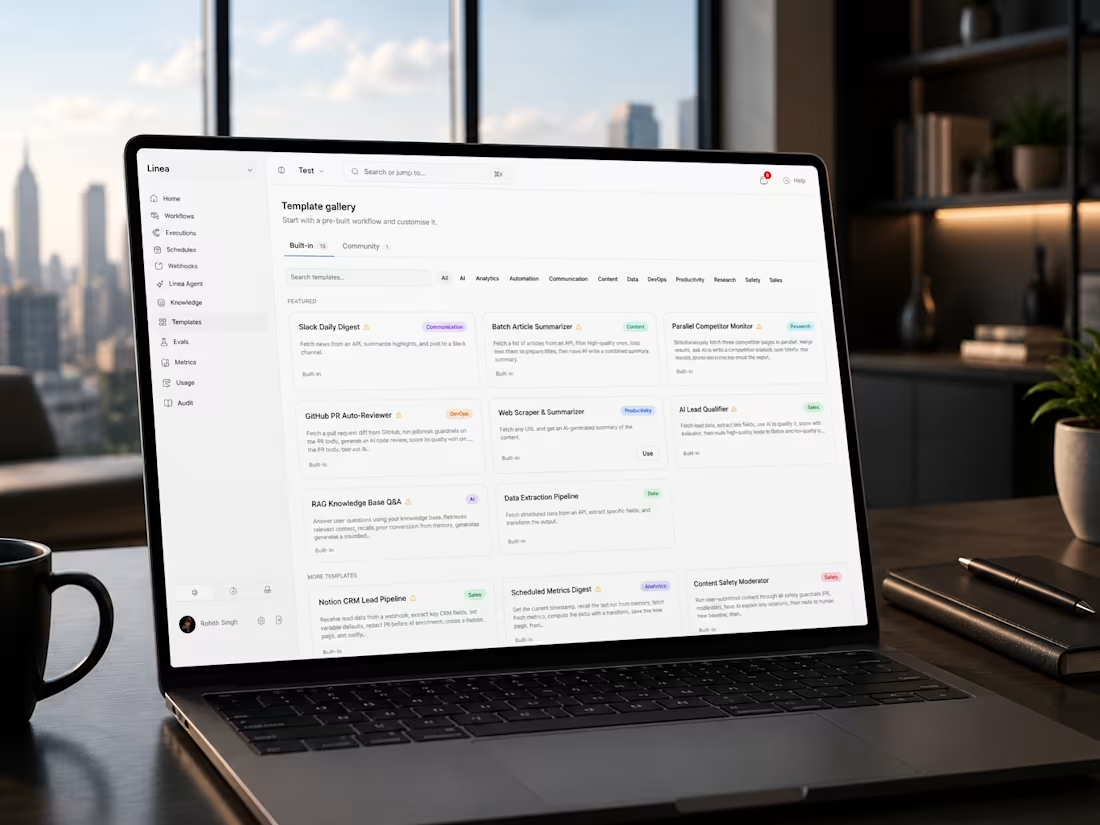
Linea was built to be that middle ground — a platform serious enough for engineering teams to trust in production, but visual enough that non-engineers can compose and modify workflows themselves.
My role
I designed and built Linea end-to-end — product direction, system architecture, and implementation across the full stack: the visual canvas, the execution engine, the agent runtime, and the infrastructure underneath it.
What I built
A drag-and-drop canvas (React Flow) for composing workflows out of 24 node types across six categories — AI agents, data transforms, memory, third-party integrations (Slack, GitHub, Notion, Gmail), control flow, and infrastructure triggers — backed by an execution engine that actually holds up under real workloads.
A few things I'm proud of in the architecture:
- Human-in-the-loop as a first-class primitive. The Approval node pauses a running workflow for human review and resumes exactly where it left off — not a bolted-on webhook, but a core part of the execution model.
- Persistent memory across runs. Workflows can read and write to memory that survives between executions, so agents get smarter the more they're used instead of starting from zero every time.
- Hybrid retrieval. The Retriever node combines vector similarity and BM25 keyword search, so workflows get the precision of keyword search and the recall of embeddings without picking one or the other.
- Provider-agnostic by design. Anthropic, OpenAI, Groq, Google, and Ollama are all interchangeable at the node level — switch models without rewriting workflows.
- Production concerns built in, not bolted on. Role-based access control and audit logging ship as defaults, not an enterprise upsell.
Tech stack
Next.js 15 + React Flow for the canvas. NestJS 11 + LangGraph.js for orchestration and agent execution. PostgreSQL 16 + pgvector for persistence and embeddings, Redis + BullMQ for queues, Clerk for auth, and pnpm + Turborepo to keep the monorepo sane.
Why this matters if you're hiring
This is the kind of project where I had to own the whole problem — product decisions about what a workflow node should and shouldn't do, backend decisions about how to keep execution reliable under concurrency, and frontend decisions about making a visual canvas actually pleasant to use. If you need someone who can take "we have a fragmented AI automation problem" and turn it into a shipped product, this is the proof.